


Education
64 million primary-school-age children are not enrolled in school. These children are at greater risk for exploitation, child marriage, and lower income-earning potential. We address barriers to education and work with communities and local governments to improve the quality of education children receive.
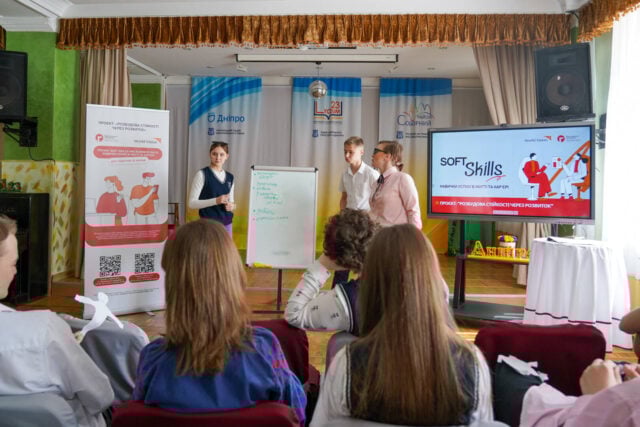
World Vision partners with a local Ukrainian nongovernmental organization to help students continue their education despite the difficulties. They also offer students soft skills training to increase their resilience in overcoming problems caused by the ongoing conflict in Ukraine.
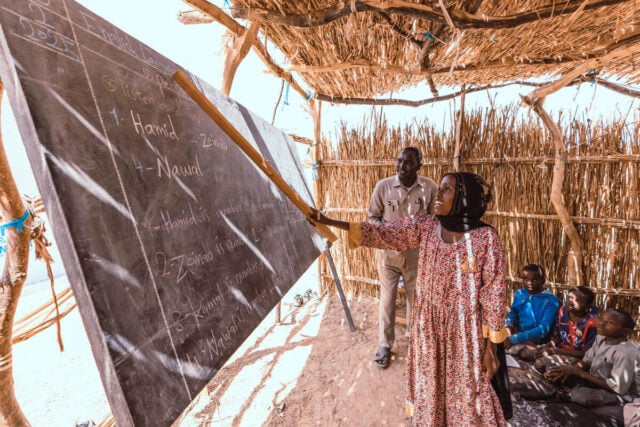
Saba, 14, studies at a school in a refugee camp far from the home she fled. Her family once lived comfortably in El Geneina, Sudan — until conflict forced them to flee to Chad with nothing but their lives. Now, Saba continues to develop her love of languages and dreams of becoming a flight engineer.

World Vision’s Classroom Wellbeing Kits offer educators extra tools to improve students’ classroom experiences, help them cope with anxiety, and channel extra energy.
We work in 66 countries
to improve quality and access to education for children.
Thanks to the support of World Vision donors around the world in 2023.
194,810
parents and community literacy facilitators trained to support children’s learning.
Thanks to the support of World Vision donors around the world in 2023.
Over 4 million
children were supported through our education programming.
Thanks to the support of World Vision donors around the world in 2023.
Our Educational Approach
Why are so many children out of school or illiterate?
Due to inadequate training of teachers in reading instruction, high ratios of students to teachers, insufficient teaching materials in children’s home language (mother tongue), and other issues, millions of young girls and boys around the world cannot read or write. These barriers are disturbing every child’s right to a quality education and ability to learn, grow and thrive.
Girls and boys often drop out of school because they must work to help support their families, because of harmful socio-cultural norms and practices (such as child marriage) that prevent them from attending and completing school, and because policies to support children’s school completion are not well reinforced. The lack of education impacts all children, but young girls are often the worst affected, having to face risks of sexual trafficking, child marriage and gender-based violence in schools.
What is World Vision doing to help children gain access to quality and equitable education?
Our approach focuses on three factors that improve children’s learning:
-
Increasing access to equitable and quality basic education, with special attention to girls and children with disabilities
-
Partnering with parents, local organizations, the private sector, and governments to galvanize greater learning outcomes and opportunities
-
Strengthening community involvement in education to create enabling environments
Does World Vision build schools and provide books and school supplies?
If a lack of supplies and proper learning environment are barriers to education, we want to address those issues in a sustainable way. Sometimes, that means utilizing corporate or government donations of appropriate teaching and learning materials, such as library books, notebooks, and other relevant school supplies.
But we strive for sustainability in all we do, so we focus on interventions like giving parents a small business loan and job training so they can support themselves and afford to send their children to school for years to come.
Education Resources
The Ethiopians Fighting Against Child Exploitation project, funded by USDOL, provided support in addressing child labor.
All Children Reading: A Grand Challenge for Development
This global initiative, co-funded and co-founded by USAID, World Vision, and the Australian government, advances EdTech innovation and research to improve reading outcomes for marginalized children in low-resource contexts.
64 million primary-school-age children are not enrolled in school. These children are at greater risk for exploitation, child marriage, and lower income-earning potential. We address barriers to education and work with communities and local governments to improve the quality of education children receive.
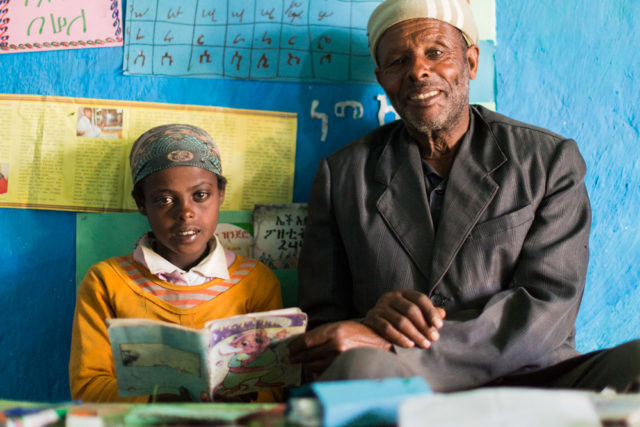
Around the world, parents encourage their children to read by creating a reading corner, a comfortable spot with good light and lots of books. Learn how.
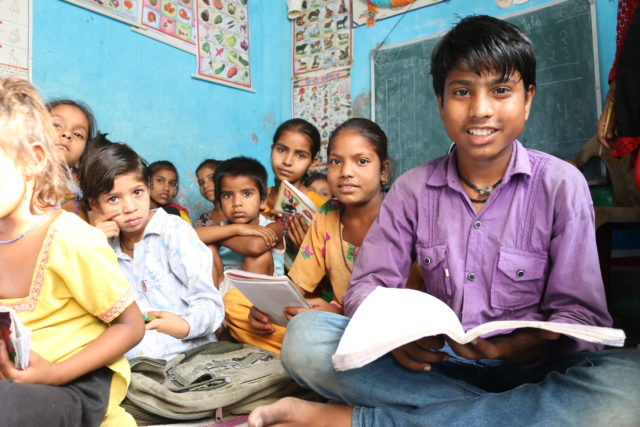
Tutoring at an informal education center prepared Mohsin, a child laborer in India, to enroll in school.
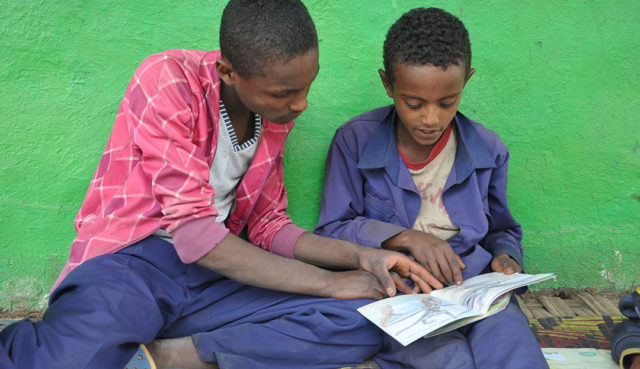
Giduma taught his siblings to read. How? Reading Buddies, a World Vision program that trains children how to read with and teach other kids how to read.
We work in 66 countries
to improve quality and access to education for children.
Thanks to the support of World Vision donors around the world in 2023.
194,810
parents and community literacy facilitators trained to support children’s learning.
Thanks to the support of World Vision donors around the world in 2023.
Over 4 million
children were supported through our education programming.
Thanks to the support of World Vision donors around the world in 2023.
Our Educational Approach
Why are so many children out of school or illiterate?
Due to inadequate training of teachers in reading instruction, high ratios of students to teachers, insufficient teaching materials in children’s home language (mother tongue), and other issues, millions of young girls and boys around the world cannot read or write. These barriers are disturbing every child’s right to a quality education and ability to learn, grow and thrive.
Girls and boys often drop out of school because they must work to help support their families, because of harmful socio-cultural norms and practices (such as child marriage) that prevent them from attending and completing school, and because policies to support children’s school completion are not well reinforced. The lack of education impacts all children, but young girls are often the worst affected, having to face risks of sexual trafficking, child marriage and gender-based violence in schools.
What is World Vision doing to help children gain access to quality and equitable education?
Our approach focuses on three factors that improve children’s learning:
-
Increasing access to equitable and quality basic education, with special attention to girls and children with disabilities
-
Partnering with parents, local organizations, the private sector, and governments to galvanize greater learning outcomes and opportunities
-
Strengthening community involvement in education to create enabling environments
Does World Vision build schools and provide books and school supplies?
If a lack of supplies and proper learning environment are barriers to education, we want to address those issues in a sustainable way. Sometimes, that means utilizing corporate or government donations of appropriate teaching and learning materials, such as library books, notebooks, and other relevant school supplies.
But we strive for sustainability in all we do, so we focus on interventions like giving parents a small business loan and job training so they can support themselves and afford to send their children to school for years to come.
Education Resources
The Ethiopians Fighting Against Child Exploitation project, funded by USDOL, provided support in addressing child labor.
All Children Reading: A Grand Challenge for Development
This global initiative, co-funded and co-founded by USAID, World Vision, and the Australian government, advances EdTech innovation and research to improve reading outcomes for marginalized children in low-resource contexts.
Ways to Give to Education
$300 worth of school supplies
An education is one of the keys to overcoming poverty, yet many children live in communities without the resources needed for learning. Crowded classrooms, under-resourced teachers, and lack of basic infrastructure can all hold kids back from getting the education they need. And the pandemic school disruptions that have resulted in far-reaching educational losses among children worldwide won’t be quickly overcome.
Thanks to corporate donations, your gift will multiply 5 times in impact to distribute essential school supplies for students in need around the world.
Become a Child Education Partner
For the more than 56% of elementary-aged children around the world who don’t meet minimum reading proficiency standards, the future can look bleak.
Together, we can do more than just get kids in the classroom — we can empower them for a brighter future, equipping them with literacy as well as essential life skills.
Monthly giving is the most effective way to help children and families who need it most. Plus, it lowers costs, which means more of your gift helps kids!
Ways to Give to Education
$300 worth of school supplies
An education is one of the keys to overcoming poverty, yet many children live in communities without the resources needed for learning. Crowded classrooms, under-resourced teachers, and lack of basic infrastructure can all hold kids back from getting the education they need. And the pandemic school disruptions that have resulted in far-reaching educational losses among children worldwide won’t be quickly overcome.
Thanks to corporate donations, your gift will multiply 5 times in impact to distribute essential school supplies for students in need around the world.
Become a Child Education Partner
For the more than 56% of elementary-aged children around the world who don’t meet minimum reading proficiency standards, the future can look bleak.
Together, we can do more than just get kids in the classroom — we can empower them for a brighter future, equipping them with literacy as well as essential life skills.
Monthly giving is the most effective way to help children and families who need it most. Plus, it lowers costs, which means more of your gift helps kids!
We work hand in hand with each community to address their unique needs — and achieve lasting change.
Choose one and see how our work gets done.


Health

Poverty in America

Economic empowerment

Clean water
Education

Christian faith

Gender equality

Disability inclusion

Refugees & fragile states

Child sponsorship